These are the ten questions from War Dossier daily challenge #46, of 7 November 2026, with the correct answer and an explanation for each. Today's challenge is a different one and it is free to play.
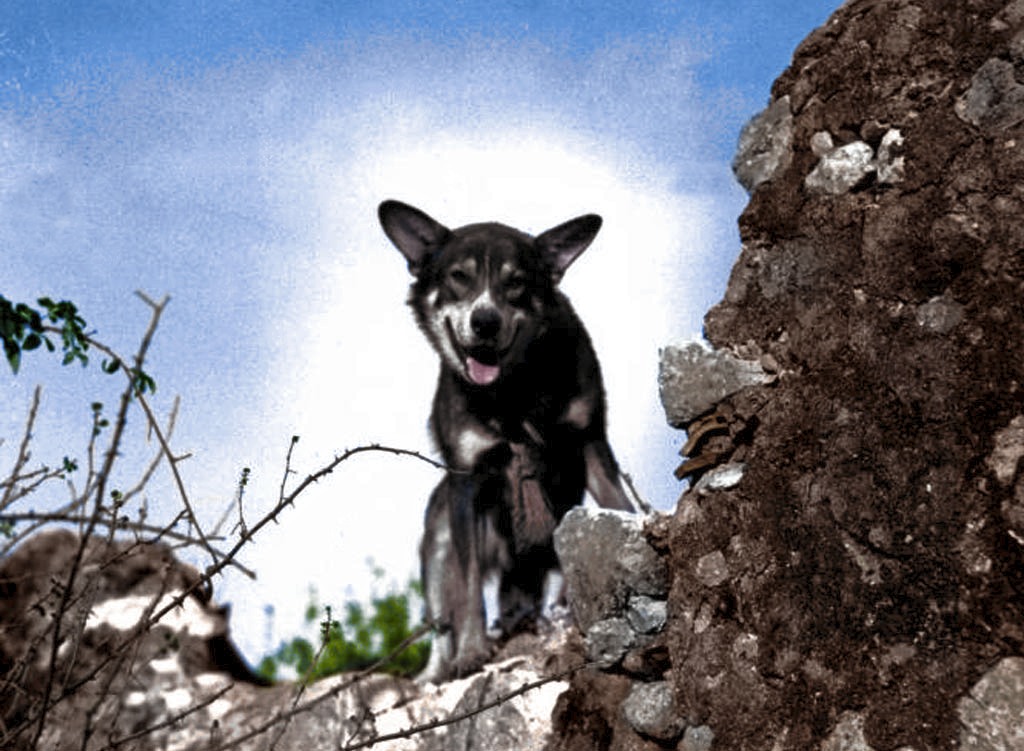
Credit: Cassowary Colorizations (coloreado a partir de foto historica, Flickr) · Licence: CC BY 2.0 · View at original source
The dossier entry: Chips, el perro más condecorado del ejército de EE.UU.
Chips was a German Shepherd-Collie-Husky mix donated by his family to the Dogs for Defense program and trained as a sentry dog. On 10 July 1943, during the Allied landings in Sicily, he attacked an Italian machine-gun pillbox and forced its crew to surrender. He was awarded the Silver Star and Purple Heart, later revoked under Army policy against formally decorating animals; in 2018 he was posthumously awarded the Dickin Medal.
Challenge answers
1 / 10
What kind of animal appears in this colourised photograph of a US Army dog?
A mixed-breed dog trained as a sentry
A purebred Belgian shepherd
A greyhound used for messaging
A Newfoundland trained for rescue
This is a German Shepherd-Collie-Husky mix, trained as a sentry dog.
2 / 10
What nickname did the USS Laffey earn after withstanding 22 kamikaze attacks in 80 minutes on 16 April 1945?
"The ship that would not die"
"The ghost of the Pacific"
"The shield of Okinawa"
"The iron battleship"
The USS Laffey earned the nickname "the ship that would not die" after surviving a combined attack of bombs and kamikazes that left it badly damaged.
3 / 10
This naval unit, made up of two light cruisers and two destroyers based at Valletta, was known as what?
Force K
Force H
Tenth Submarine Flotilla
Eastern Mediterranean Squadron
Force K, with the cruisers Aurora and Penelope and the destroyers Lance and Lively, operated from Malta in 1941.
4 / 10
Once the depth flaw was fixed, what other torpedo component turned out to be failing?
The magnetic exploder
The propeller
The gyroscopic guidance system
The outer casing
Once the depth flaw was fixed, the magnetic exploder was found to be failing too, detonating early or not at all.
5 / 10
Which Far Eastern territories was it agreed the USSR would receive in exchange for its commitment to enter the war against Japan?
Southern Sakhalin and the Kuril Islands
The Philippine Islands
The whole Korean peninsula
Hong Kong
It was agreed the USSR would receive southern Sakhalin and the Kuril Islands, plus interests in Manchuria, conditional on its entry into the war against Japan.
6 / 10
Which of these two ships entered service earlier: the USS Enterprise (CV-6) or the Bismarck?
USS Enterprise (CV-6)
The Bismarck
They entered service in the same year
Neither ever entered service
The USS Enterprise entered service in 1938, two years before the Bismarck in 1940. The American carrier survived the entire war, while the German battleship was sunk barely a year after entering service.
7 / 10
From what region was Maxime Weygand urgently recalled to take command?
From the Near East
From North Africa
From Paris itself
From the Italian border
Weygand was urgently recalled from his post in the Near East to take French supreme command.
8 / 10
What advantage did the PIAT have over the Bazooka or Panzerfaust when firing from enclosed spaces?
It had almost no muzzle flash or rear gas jet
It could be fired underwater
It made no sound at all when fired
It had a longer range than a tank gun
Being a spring-propelled spigot mortar rather than a rocket or recoilless weapon, the PIAT produced almost no muzzle flash or rear gas jet, making it reasonably safe to fire from inside buildings.
9 / 10
Which French volunteer pilot squadron became famous flying the Yak-3 on the Eastern Front?
The Normandie-Niemen regiment
The Lafayette Escadrille
The Storks Fighter Group
The Condor Legion
The French Normandie-Niemen regiment, integrated into Soviet aviation, flew the Yak-3 with great success on the Eastern Front, and several of its pilots were even allowed to take their aircraft home to France after the war.
10 / 10
Roughly how many Pak 36 units were produced between 1933 and 1943?
About 20,000
About 2,000
About 200,000
About 500
About 20,000 units were produced, a high figure reflecting its role as the standard anti-tank weapon early in the war, before being relegated to secondary duties.
Today's challenge is another ten questions. No sign-up, nothing to install.